°
°
NoTF Solutions Catalogue
A working book that makes local solutions legible, replicable, and ready to travel.
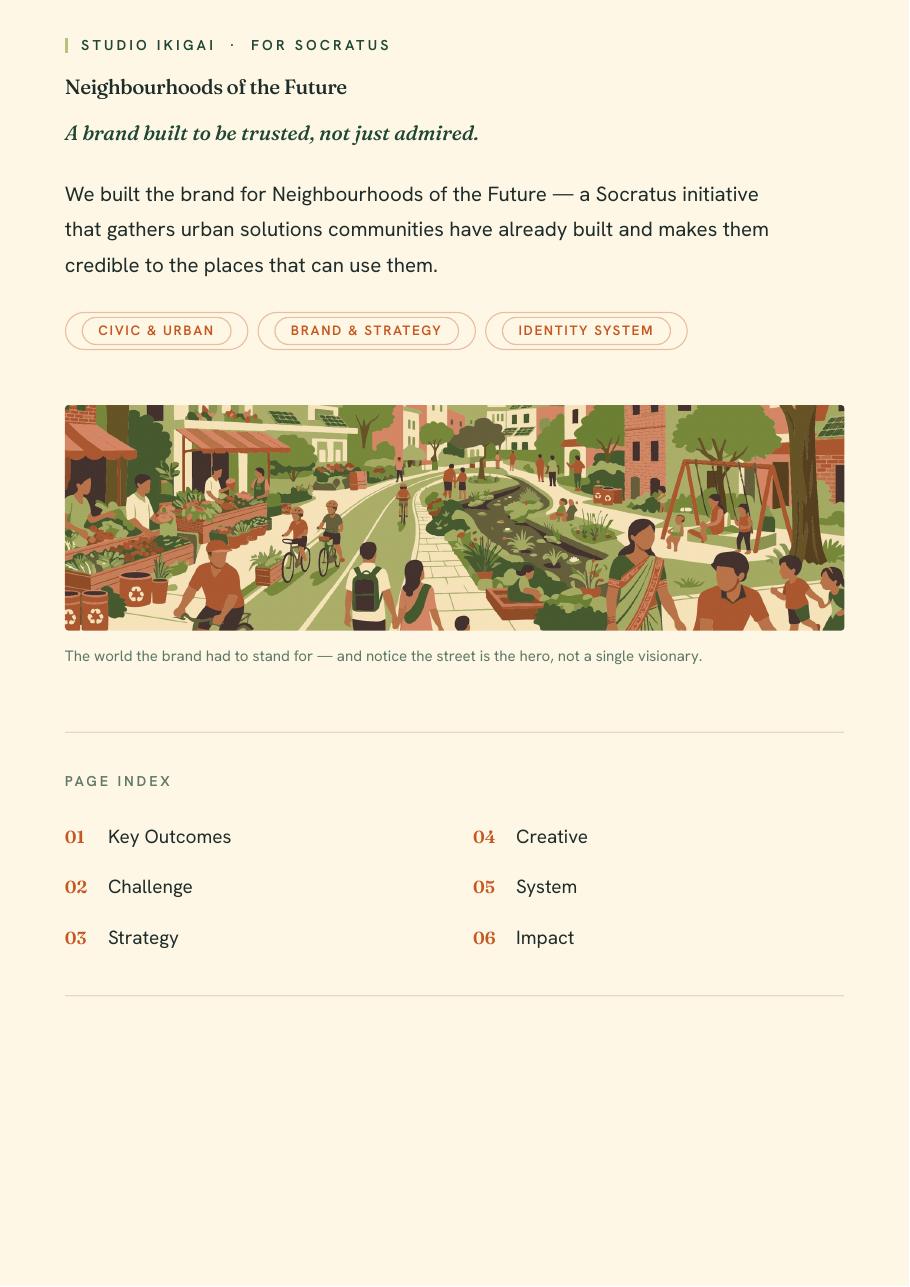
A first-edition catalogue documenting twenty place-based, community-led solutions from across Bengaluru and beyond, gathered with the Neighbourhoods of the Future programme. We designed the editorial system, the eight-theme architecture, the cover and section identities, and the production pipeline that lets new solutions slot in over time.
What we delivered
Twenty scattered programmes, each captured as a who / why / how / what-it-achieved entry a stranger can act on.
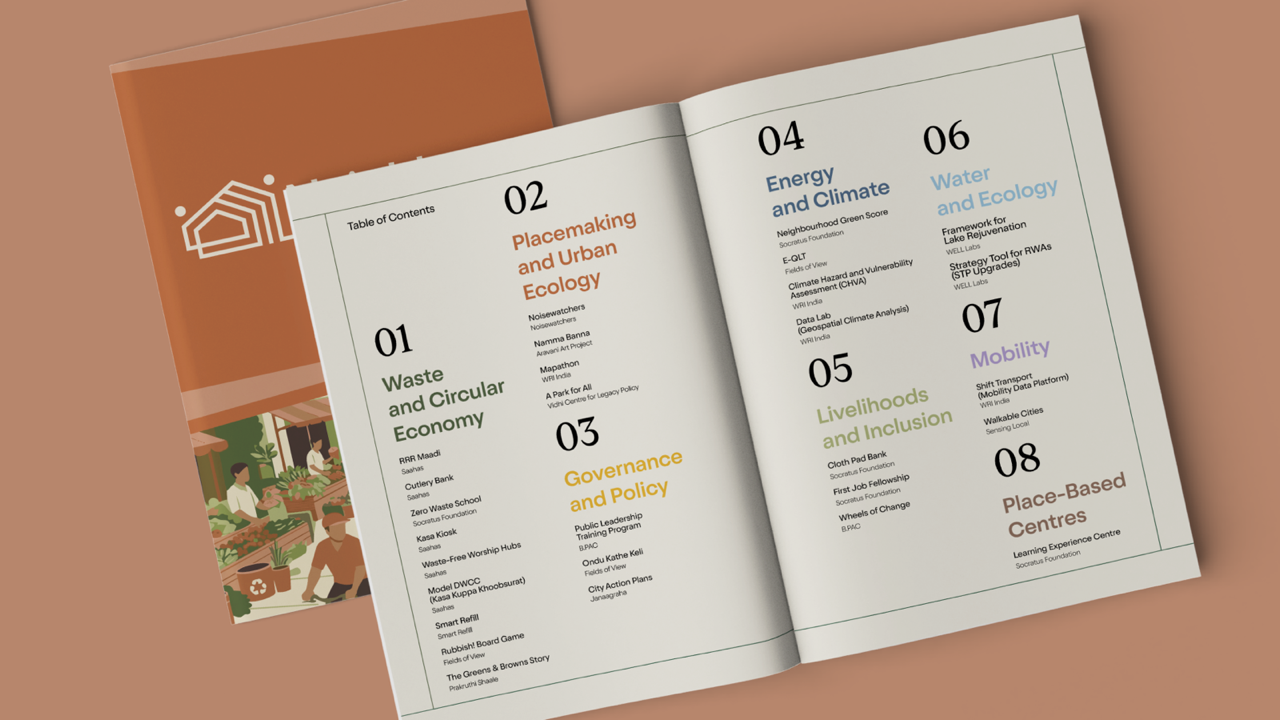
From Waste & Circular Economy to Place-Based Centres, so the book is navigated by problem, not by organisation.
A template at the back means new solutions slot in over editions without a redesign. Built to grow, not be reprinted.
Twenty solutions that made no shape
The solutions already worked. What they lacked was legibility. Twenty partners, Saahas, WRI India, Janaagraha, WELL Labs, Fields of View and others, each held a programme that was small, specific and deeply local. Read together they made no shape. A funder could not browse them, a neighbourhood could not borrow them. The brief was to turn a folder of disparate efforts into a single object someone could pick up and use.
A catalogue as infrastructure
We treated the catalogue as infrastructure, not a brochure. The work was organised into eight themes, so the book is navigated by the problem a reader has, not by which organisation owns the answer. Every solution answers the same four questions in the same order, so comparison is effortless and nothing reads as a sales pitch.
Find a project. Bring it home. The book is a working document, not a record of finished things.
Eight themes, one palette
Each of the eight themes carries its own colour and a flat, friendly icon: a four-arrow loop for waste, an artist’s palette for placemaking. Headlines in a warm serif, body in a clean grotesque, impact figures inside linked circles down a coloured rail so numbers read as a quiet rhythm, not a dashboard. Section dividers give each theme a full-bleed colour field and a one-line promise.
What the book carries
First edition: twenty solutions across eight themes, from twelve-plus partner organisations. A single object a funder can browse, a neighbourhood can borrow from, and the programme can point to as one body of work.