°
°
Sanskrit Verb Lookup
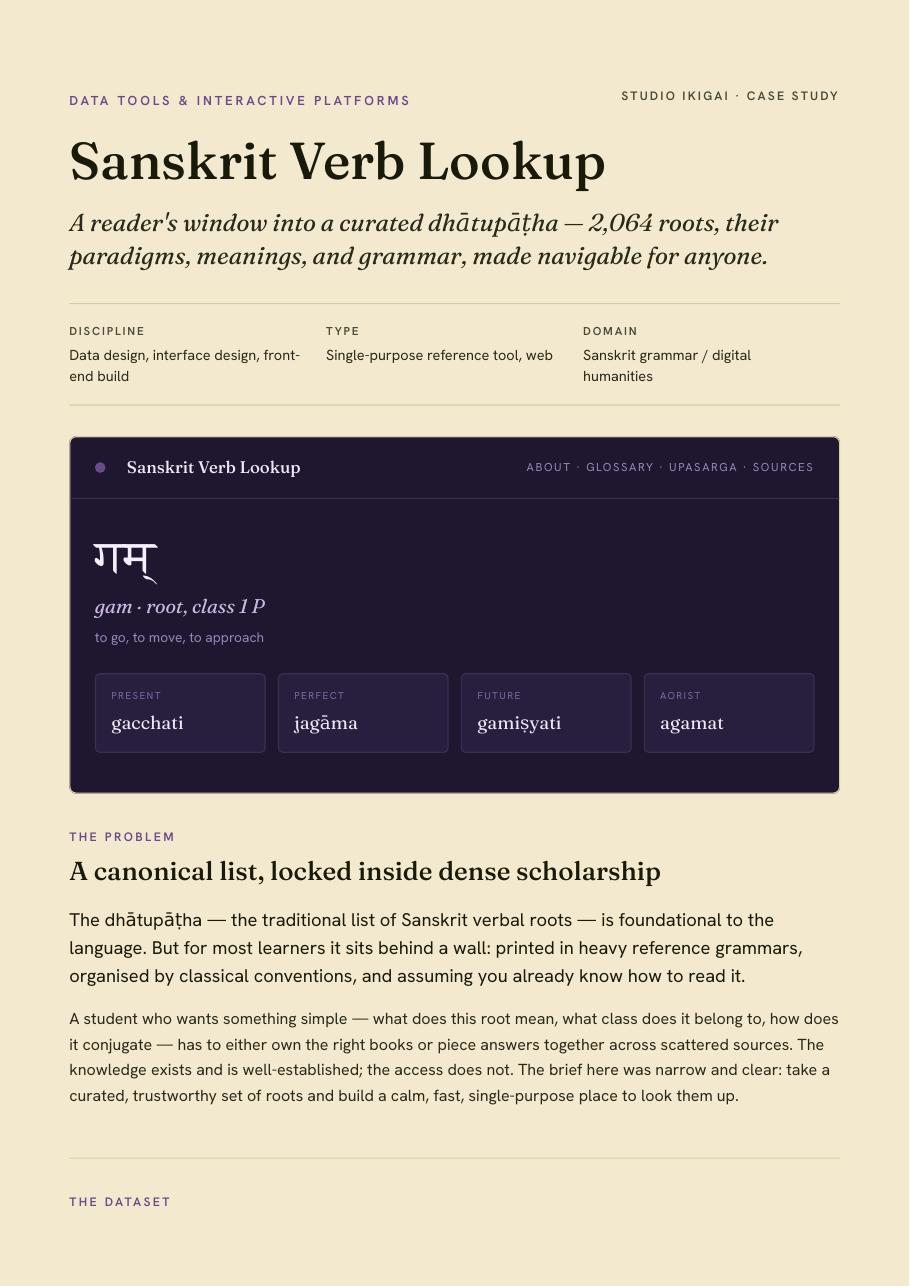
A reader’s window into a curated dhātupāṭha: 2,064 roots, their paradigms, meanings and grammar, made navigable for anyone.
A calm, fast, single-purpose place to look up Sanskrit verbal roots. The work was as much about structuring the data cleanly as presenting it: normalising transliteration, holding Devanāgarī and Roman side by side, and tagging each entry so it can be searched, filtered and cross-referenced.
A canonical list, made navigable
A focused lookup tool that puts a curated dhātupāṭha within reach of students, readers, and anyone curious about how Sanskrit verbs behave.
Locked inside dense scholarship
The dhātupāṭha, the traditional list of Sanskrit verbal roots, is foundational to the language. But for most learners it sits behind a wall: printed in heavy reference grammars, organised by classical conventions, and assuming you already know how to read it. A student who wants something simple, what a root means, what class it belongs to, how it conjugates, has to own the right books or piece answers together across scattered sources.
2,064 roots, structured for retrieval
The catalogue draws on a curated dhātupāṭha, with each root carrying its paradigms, meanings and grammatical metadata. As much work went into structuring that data cleanly as presenting it: normalising transliteration, holding Devanāgarī and Roman side by side, and tagging each entry so it can be searched, filtered and cross-referenced.
Built for the reader, not the grammarian
A reader can come in by Devanāgarī, by transliteration, or by English meaning, and the lookup tolerates how people actually type Sanskrit rather than demanding diacritical precision up front. Each entry resolves to a single legible page, meaning, class and paradigms in a fixed order. A glossary, a prefix reference and a plain how-to sit one tap away, so the tool teaches its own conventions.
It wasn’t the Sanskrit. It was making a centuries-old reference feel like it was built for the person reading it today.
A quiet, useful resource
A focused tool that does one thing well, live, fast and self-explanatory. The root data is structured once and shipped as part of the site, so lookups are immediate and the tool stays cheap to host and simple to maintain: a small piece of digital infrastructure for a language that has too little of it.